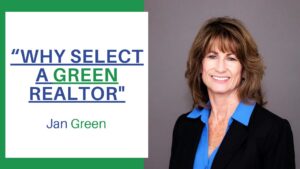
We recently welcomed member Jan Green to our Weekly Wednesday Webinar CEU series.
Below, you can find the recording of that talk, an article based on the recording, the attendee survey summary, and additional Q&A from the webinar.
Webinar attendees reported learning a wide range of new information about green realty and sustainable home features. Many participants were surprised to discover the existence of green realtor certifications, such as the NAR Green Designation and Pearl Certification, as well as the relatively small number of realtors currently holding these credentials. Attendees learned about the various professionals and roles involved in selling a green home, the importance of working with knowledgeable inspectors, and resources like the Green Building Registry and Active Rain. The session also highlighted the value of energy audits, the life expectancy of green components, and how green features can be clearly described and valued in property listings to attract buyers.
This article explores the vital role of green realtors in advancing sustainable practices within the residential housing market. Drawing from the expertise of a leading green-designated realtor, it provides an in-depth look at what defines a green realtor, the value of energy-efficient and high-performance homes, the complexities of marketing and appraising green features, and practical guidance for housing professionals and the public alike. The discussion is grounded exclusively in the insights and case studies presented in a recent educational session, highlighting both technical details and accessible explanations for a broad audience. The article concludes with a Q&A segment derived from audience interaction, followed by a summary of key takeaways.
The Critical Role of Green Realtors in High-Performance Home Transactions
Introduction
Designing, building, and renovating green homes are all important, but the impact of these efforts is limited if the value and benefits of high-performance, sustainable housing cannot be communicated effectively to buyers and sellers. The challenge lies not only in the technical aspects of sustainable construction but also in bridging the knowledge gap between the professionals who create these homes and the broader market that must understand and embrace them. This article examines the unique perspective and practices of green-designated realtors, focusing on their essential role in educating, marketing, and facilitating the successful sale of sustainable homes.
What Is a Green Realtor?
A green realtor is distinguished by formal education and credentials in sustainability and high-performance housing. Designations such as NAR Green, EcoBroker, and certifications like LEED Green Associate or WELL AP indicate a commitment to ongoing learning and a business model that integrates people, planet, and profit. These professionals approach real estate transactions with a focus on sustainability, always considering the environmental and health impacts of homes, as well as their economic benefits.
Green realtors are adept at sourcing specialized trades, working with appraisers familiar with high-performing homes, and employing a different methodology than conventional practitioners. Their expertise is often sought after by peers for education and for elevating industry standards. For instance, they possess the skills to calculate the value of owned solar systems for listing prices, utilizing tools like PVvalue.com.
The Business Case for Energy Efficiency
Energy efficiency in homes is profitable, but the beneficiaries vary. Builders, trades, and vendors may receive rebates, incentives, and sometimes tax credits, while homeowners typically benefit through utility savings and, potentially, higher appraisals. However, the communication and realization of this value depend heavily on the knowledge and actions of the realtor.
Many realtors lack familiarity with energy efficiency and sustainable features. Nationwide, only a small fraction have earned green designations; in Arizona, for example, fewer than 100 out of over 88,000 realtors possess such credentials. This knowledge gap often leads to missed opportunities in marketing, valuation, and buyer education.
Core Responsibilities of a Green Realtor
Educating Clients and Industry
Green realtors play a continual educational role, informing clients, peers, and the public about the benefits and specifics of high-performance housing. They clarify what makes new or retrofitted homes energy efficient, interpret certifications and ratings, and explain the relevance of local and national programs. In Arizona, for example, programs like the Scottsdale Green Building Program and Pearl Certification offer third-party verification of performance.
Navigating the MLS and Marketing Green Homes
Green realtors maximize the visibility and value of sustainability features by leveraging Multiple Listing Service (MLS) tools. They understand the importance of accurately listing features such as Energy Star appliances, SEER ratings, insulation levels, renewable energy systems, water-saving fixtures, and indoor air quality improvements. Features must be documented clearly and, where possible, with dates of installation and cost, as appraisers cannot assign value without such detail.
Marketing strategies are tailored to highlight energy efficiency in public remarks, photographs, and documentation tabs, always mindful of the limitations and rules specific to each MLS. The placement and wording of green features are strategic, as studies have shown buyers focus primarily on the first sentences of property descriptions.
Addressing Greenwashing and Liability
A persistent challenge is greenwashing: the overstatement of environmental benefits or mislabeling of features. Green realtors take care to avoid broad, unsubstantiated claims, instead providing specific, fact-based descriptions. They also clarify distinctions between realtors and real estate agents, particularly regarding the use of professional designations and the associated ethical obligations.
Advising on Home Upgrades and Retrofits
When advising clients on upgrades, green realtors advocate for a “start small” approach, focusing first on practical improvements such as insulation, duct sealing, efficient HVAC systems, and water-saving devices before considering larger investments like solar panels. They emphasize the importance of energy audits to identify the most cost-effective measures and to provide a roadmap for future improvements.
Spotting Red Flags in Resale and Retrofit Homes
Green realtors are trained to identify potential issues in both new and retrofitted homes, from missing insulation in room additions to indoor air quality problems related to mold, asbestos, or volatile organic compounds. They utilize historical listing data, infrared imaging, and collaboration with home inspectors to uncover hidden defects that could impact comfort, safety, or efficiency.
Appraising and Valuing Green Features
The appraisal of high-performance homes remains a complex issue. Green features, including owned solar systems, upgraded insulation, and advanced HVAC, require thorough documentation to be considered in valuation. Appraisers must be qualified—ideally certified in green appraisal practices—and provided with detailed lists of features, specifications, and utility data.
Tools such as the Residential Green and Energy Efficient Addendum and PVvalue.com are essential for substantiating claims and assigning value to specific upgrades. However, leased or financed solar panels generally do not contribute value in appraisals due to legal and title constraints.
Realtors play a proactive role by contacting lenders early in the transaction to request green-certified appraisers, preparing comprehensive documentation, and educating all parties involved about the nuances of valuing high-performance homes.
Case Studies: Real-World Impact
The article includes examples of successful transactions where green realtors have added value through careful documentation and marketing of sustainability features. In one case, a home that previously failed to sell was relisted with detailed feature lists and supporting documentation, resulting in a sale at the appraised value. These successes underscore the importance of preparation, transparency, and collaboration among realtors, appraisers, and clients.
The Future of Green Real Estate
The housing market is evolving, with increasing demand for transparency, efficiency, and sustainability. Tools like the U.S. Green Building Registry and evolving software standards (such as UAD 3.6) are making it easier to track and communicate green features. Nonetheless, the expertise of green realtors remains critical in translating technical details into market value and in overcoming persistent barriers in the appraisal and sales process.
Green realtors also advocate for ongoing education within the profession, encouraging peers to pursue green designations and to stay current with innovations in building science, marketing, and policy.
As for realtors providing a HES score to clients – it would be a better idea for them to earn a green designation first to have a base of knowledge and to understand the terms and benefits of features. By earning a GREEN designation first, they stand a better chance of understanding the terms used in a HES and providing useful information to clients. They would also be more included to recommend a HES score for a homeowner. Remember, realtors are sales people not trained in EE. If no one is offering HES in AZ, it’s less likely a realtor would seek that kind of information.
Estimating the number of solar panels needed to charge an EV can be difficult. You’d need a full year of utility bills to understand how your EV’s energy use changes with the seasons.
In Arizona’s extreme heat, we use a lot more electricity and often charge daily when we’re showing homes back-to-back. On 115-degree days, the air conditioning runs before, during, and after appointments. Because our service area spans about 500 square miles, we may need to charge every day—unlike in the winter, when we enjoy much milder weather.
EV energy use isn’t consistent throughout the year, so there’s no reliable year-round average. Besides, a realtor may sell 10 homes one year and 20 the next.
Visit this link to search for a green certified appraiser. Make sure to click on the state so they are in Alpha order. Share that list when seeking a green appraiser.
https://ai.appraisalinstitute.org/eweb/Dynamicpage.aspx?webcode=AIPDPDirectory&key=428cdb90-9814-47e4-9256-a4113c815862
For the survey and response:
Adding education green designations to my business has been a huge asset. Clients value additional knowledge, and I feel it helps build trust. They’re reading testimonials more often, and several have found me through AI—not just through my most recent sale in Phoenix.
In January, I’ll be selling a $2.3 million home referred to me by a local Realtor who has retired. After 15 years of seeing the knowledge I’ve shared, she trusts me to take good care of her clients. The Canadian seller has researched me and feels comfortable selling his home remotely. The seller works in IT so I’m sure he’s vetted me extensively. Trust is huge in real estate.
This retired agent could have easily referred this client to anyone else, and she knows many in the real estate industry. But she chose me over other realtors. It’s advanced knowledge and others see it as an asset above a traditional agent, not just that I’ve sought and earned green credentials. It’s the level of expertise in real estate and /knowledge that is seen as an advantage over other agents.
Please clarify that the Residential Green & Energy Efficient Addendum was created and shared live on the Appraisal Institute website in about June 2010. The UAD 3.6 software is going live on 11/2/26, depending on software availability.
Every person passing the real estate exam in their respective state is a real estate agent. Only those becoming members of the National Association of REALTORS® become REALTORS®. REALTORS® subscribe to NAR’s strict Code of Ethics and benefit from education and credentials, including the GREEN designation.
Follow up summary:
The U.S. housing market has never offered such a wide range of homes. It’s up to industry professionals to stay educated and informed so they can best serve the public.
Before choosing a real estate agent, buyers and sellers should interview them. Ask how many homes they sell each year, what advanced education they’ve pursued to stay current with today’s market, and how they use that knowledge to benefit their clients.
Without an interview, how can buyers and sellers know what level of service to expect?
Q&A: Insights from Industry Discussion
Q: How do you get clients to care about sustainability and energy efficiency? Are you seeing higher listing or sales prices?
A: Energy efficiency and sustainability are introduced at the very first meeting with buyers and sellers, with emphasis on health, utility savings, and long-term value. Documented features and clear explanations often lead to increased interest and, in some cases, higher appraisals.
Q: What advice do you have for home inspectors or energy auditors seeking to collaborate with realtors?
A: Real estate agents should encourage home inspectors to study building science and earn energy-auditor credentials. These qualifications can benefit inspectors, agents, and clients, while a bundled inspection and energy-audit service adds value for homebuyers and advances the industry. Although offering this additional service may increase inspectors’ liability, more detailed information about a home’s performance could also help reduce it.
Q: Does solar ever hurt a home’s value?
A: Leased and 3rd party financed solar panels DO NOT add value, and both can complicate transactions. Owned systems, properly documented, can increase appraisal value using tools like PVValue.com.
Q: How should green features be documented for appraisers?
A: Provide detailed, itemized lists of all upgrades, dates of installation, costs, and supporting documents such as utility bills and certifications. Upload these to the MLS and present them directly to appraisers.
Q: What is the role of artificial intelligence (AI) in green real estate?
A: Ai is a useful tool to help define public remarks, especially when it comes to energy efficient features. Our limit for public remarks in Arizona is 800 characters. Ai can help concisely describe features, but make sure you aren’t abusing greenwashing by misrepresenting the features. My advice to agents is to have a seller explain each feature so you understand it and can share that knowledge.”
Key Takeaways
- Green realtors bring specialized knowledge to the marketing, valuation, and sale of high-performance homes.
- Accurate documentation and transparent communication of green features are essential for realizing value in real estate transactions.
- Energy audits and phased improvements provide the best return on investment for homeowners.
- Appraising green homes requires collaboration, qualified appraisers, and detailed supporting materials.
- Leased or financed solar systems do not contribute to home value; owned systems, properly documented, can.
- Ongoing education and industry engagement are critical for advancing sustainability in real estate.
- Artificial intelligence can support but does not replace the need for professional expertise in green real estate.
- The role of the green realtor is increasingly important as demand for sustainable housing grows.