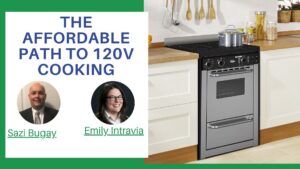
Recently, Sazi Bugay and Emily Intravia joined us for the weekly Wednesday free CEU webinar to talk about The Affordable Path to 120V Cooking.
We captured the recording of this webinar for you to watch, an article based on the transcript if you prefer to read it, additional Q&A not answered during the session, and a survey summary of the attendees.
Attendees learned that induction cooking is much more efficient and safer than traditional gas or electric ranges, with new 120V induction models like those from WattSipper making it possible to use induction technology in older homes and apartments without major electrical upgrades. These ranges use power sharing between the cooktop and oven, often only requiring an upgrade to a 20-amp outlet—an affordable change that may be offset by rebates and incentives that are still available. The webinar highlighted how induction ranges save energy, offer environmental benefits, and provide features such as better insulation, improved safety, and compatibility with common cookware like cast iron. Participants also appreciated learning about the practicalities of switching to induction, the importance of magnetic cookware, the continued push for more efficient kitchen appliances, and how these innovations make induction accessible for more households, especially in multifamily and older buildings.
This article explores the transformative potential of 120-volt induction cooking technology in the context of residential electrification. Drawing from the expertise of Sazi Bugay and Emily Intravia, it examines the challenges of upgrading legacy housing stock, the technical and practical aspects of 120V induction ranges, and the broader implications for health, efficiency, and sustainability. The discussion is aimed at housing professionals, builders, and contractors, with accessibility for the general public, offering a technical yet approachable overview of how low-power induction appliances can accelerate the transition away from gas cooking without costly electrical upgrades.
The Affordable Path to 120V Induction Cooking: Electrifying American Homes Without Major Upgrades
Introduction
Electrification of the U.S. housing stock stands as a pivotal step in decarbonization and indoor air quality improvement. While advances in heat pump technology for HVAC and water heating have made significant inroads, the kitchen—specifically, cooking appliances—remains one of the final hurdles for widespread electrification. The dominance of gas cooking, especially in older homes with limited electrical capacity, presents both cultural and technical challenges. Yet, recent developments in 120-volt induction ranges offer a pragmatic, affordable, and health-conscious solution for both multifamily and single-family residences, enabling a plug-and-play path to all-electric kitchens.
The Challenge: Legacy Housing and Electrical Constraints
The United States is home to approximately 140 million housing units, with 40% built before 1980. Many of these structures rely on 60-amp electrical panels and gas connections standard in that era. While upgrades such as heat pumps for both water and space heating have become more accessible, transitioning to electric cooking has historically required costly service panel upgrades and new 240V circuits—an often prohibitive barrier for property owners and tenants alike. The cost of such upgrades, especially in states like California and New York, can reach several thousand dollars, making electrification unattainable for many.
Induction Cooking: A Technical Overview
Induction cooking utilizes electromagnetic fields to directly heat compatible cookware, offering speed, efficiency, and safety advantages over both gas and traditional electric (radiant or coil) cooking. Unlike gas, induction does not emit combustion byproducts, and unlike radiant electric, it delivers heat directly to the pan, minimizing wasted energy. Surveys indicate that about 80% of home cooking takes place on the cooktop, with ovens being used primarily during holidays and special occasions. Induction cooktops respond quickly to temperature adjustments, provide precise control, and remain cool to the touch, reducing burn risk and making them especially safe for families and older adults.
The 120-Volt Solution: Engineering for Retrofit
The innovation of 120V induction ranges lies in their ability to work within the electrical constraints of older homes. Most U.S. residences have 15- or 20-amp circuits in kitchens. The new generation of 120V induction ranges is designed for 20-amp outlets (drawing up to 1800 watts), with future possibilities for 15-amp versions. This design enables direct replacement of gas or electric ranges without panel upgrades, hardwiring, or extensive permitting. For property managers and housing authorities, this means lower installation costs, minimal disruption, and broad compatibility with existing infrastructure.
Dynamic power allocation is a defining feature: these ranges intelligently share available power between the cooktop and oven cavity. Since simultaneous high-demand use of all burners and the oven is rare in typical households, this “smart sharing” provides ample functionality for daily cooking while staying within safety and code requirements.
Efficiency, Safety, and Health Benefits
Induction cooking is the most efficient residential cooking technology currently available. While gas cooking delivers less than 40% of its energy to the food, induction can achieve 90-95% efficiency. This translates to faster boiling times, reduced waste heat in the kitchen, and lower utility bills. The induction surface itself remains relatively cool, and recent UL safety standards now require oil temperature sensors to prevent overheating and potential fires—a significant advancement in kitchen safety.
From a health perspective, eliminating gas combustion in the home directly improves indoor air quality, reducing exposure to nitrogen dioxide, carbon monoxide, and particulate matter. For multifamily buildings, this is especially valuable, as shared ventilation and high tenant turnover can exacerbate the risks associated with gas appliances.
Practical Considerations: Sizing, Installation, and Maintenance
Modern 120V induction ranges are available in standard American sizes (20, 24, and 30 inches), making them suitable for everything from compact apartments to family kitchens. Oven cavities, typically ranging from 2.5 to 3 cubic feet, accommodate full baking sheets and even large turkeys, addressing concerns about functionality for holiday cooking.
Installation is straightforward: these ranges are truly plug-and-play, requiring only a standard dedicated 20-amp circuit. Compared to the $6,000–$12,000 cost of a full panel and circuit upgrade, swapping a single outlet is a minimal investment. Maintenance is simplified by modular designs using standard electrical components, and cleaning is easier thanks to flat glass surfaces and steam-clean oven options.
Cookware Compatibility
Induction cooking requires pots and pans with magnetic (ferrous) bases. Today, most cookware is labeled as induction-compatible, including stainless steel, cast iron, and many ceramic-coated options. A simple magnet test can confirm compatibility. For property owners concerned about tenant transition, starter cookware sets can accompany new installations, smoothing the adoption curve.
Comparing Induction, Gas, Radiant Electric, and Microwave Cooking
Time-to-boil comparisons reveal that 120V induction is competitive with gas and significantly faster than radiant electric, especially at lower wattages. The direct heat transfer of induction reduces ambient heating—a key consideration in small apartments or in warm climates. While microwaves are efficient for reheating, their limitations in real cooking and food quality make induction the preferred choice for healthy, versatile meal preparation.
Addressing the 15-Amp Dilemma
While the current generation of 120V induction ranges is optimized for 20-amp circuits, many older homes have only 15-amp outlets. Upgrading a kitchen outlet to 20 amps is a comparatively minor electrical job and is often incentivized by state or local programs. This modest investment is far less costly than upgrading to 240V service for conventional electric ranges.
Incentives and Policy Context
Rebates and incentives play a crucial role in accelerating adoption. Federal programs, such as those created under the Inflation Reduction Act, offer substantial rebates for induction ranges—up to $840 for qualifying households. Some states and utilities (notably in California and New York) provide additional rebates, and new policies are emerging to support electrification of affordable and multifamily housing. However, evolving federal guidelines may limit certain types of fuel-switching rebates after 2026, underscoring the urgency for early adoption and careful project planning.
Environmental and Social Impacts
Transitioning to 120V induction ranges supports wider decarbonization efforts, reducing greenhouse gas emissions and fossil fuel dependence. For property managers, the benefits extend to easier maintenance, improved resident health, and compliance with emerging building codes. For residents, especially in dense urban areas, electrification means quieter, cooler, and safer kitchens.
Looking Ahead: Market Adoption and Future Directions
Europe leads the world in induction cooking adoption, with over 65% of households using induction cooktops. In the U.S., this number remains low but is poised to grow rapidly as affordable, compatible products become widely available. As more builders and contractors embrace these technologies, the supply chain will diversify, costs will decrease, and consumer familiarity will increase.
Manufacturers are prioritizing accessibility features such as front-mounted controls for ADA compliance, and are designing appliances to fit shallow cabinets and tight spaces found in older urban housing. The shift to 120V induction cooking is not just a technical upgrade but a rethinking of how kitchens can be healthier, more efficient, and more resilient for all.
Q&A Discussion
Q: Are 120V induction ranges compatible with 15-amp circuits, or is a 20-amp outlet required?
A: Current models require a 20-amp outlet, drawing up to 1800 watts. Upgrading a 15-amp outlet to 20 amps is a straightforward and affordable electrical job, much less costly than installing a 240V circuit.
Q: How does 120V induction performance compare to 240V induction and traditional gas ranges?
A: While 240V induction offers the shortest boiling times, 120V induction is highly efficient and competitive with gas for most daily cooking. The difference in speed is noticeable primarily when all burners are used at maximum power, which is rare in typical use.
Q: What about cookware compatibility?
A: Induction requires magnetic cookware. Most modern pots and pans are labeled as induction-friendly. If a magnet sticks to the base, it will work. Cast iron, stainless steel, and many ceramic-coated pans are compatible.
Q: Are there safety concerns with induction cooking?
A: Induction is among the safest cooking technologies. Surfaces remain cool, and new UL standards require oil temperature sensors to prevent fires. Units also feature automatic shutoff and pan detection, further reducing risks.
Q: Can all burners be used on high at the same time?
A: Smart power management limits total output to remain within circuit safety limits. While all burners can be used, full power may not be available simultaneously; the range will allocate power dynamically.
Q: What is the typical oven size, and can it accommodate large meals?
A: Oven cavities in 120V induction ranges range from 2.5 to 3 cubic feet, sufficient for standard baking sheets and large roasts (e.g., a 20-pound turkey).
Q: Are rebates available for these appliances?
A: Substantial rebates are available at federal, state, and utility levels. Details vary by location and income eligibility, so check local resources for current programs.
Q: What about maintenance and service?
A: 120V induction ranges are designed with standard components for easy maintenance, and cleaning is simplified by flat surfaces and enamel oven cavities. No battery maintenance is required.
Q: Is Wi-Fi or smart connectivity required?
A: No. While smart features can be added, most models focus on simplicity and reliability, avoiding unnecessary connectivity that can complicate turnover in rental properties or raise privacy concerns.
Q: What is the price range for 120V induction ranges?
A: Prices typically range from $1,500 to $2,300 before rebates, depending on size and features. Multifamily projects may access bulk purchasing and additional incentives.
Q: What is the easiest way to recognize a NEMA 5-20R receptacle?
A: The easiest way to recognize a NEMA 5-20R receptacle is by its distinctive “T-slot” configuration. While a standard 15-amp home outlet has two parallel vertical slots, the 5-20R includes a horizontal cutout branching off one of the vertical slots. This design allows it to accept both standard 15-amp plugs (NEMA 5-15P) and dedicated 20-amp plugs (NEMA 5-20P), which feature one horizontal prong. Note: Must use 12AWG wire (not common 14 gauge).
Q: What are the installation requirements for a Wattsipper range?
A: For best results and proper operation, a dedicated 20 Amp circuit and a NEMA 5-20R receptacle behind the range are required. Safety certification of the unit through a regulatory CB has been provided with this condition, and information on the requirements is given both at the website and in the product documentation.
Q: Would you compare induction cooking to microwave cooking?
A: Induction cooking creates magnetic waves to heat the ferrous pot or pan, which in turn cooks the food inside the vessel. Microwave cooking, on the other hand, uses microwaves generated by a magnetron to penetrate the food in a non-metal dish, energizing the water molecules to create heat and cook the food.
Q: Where can we find documentation to verify the figure that approximately 140 million homes were built before 1980?
A: Total housing stock in the US is 140 million (including single-family and multifamily residential units) and nearly 50% of this stock was built before 1980. Source: NAHB Blog – How Old is Today’s Housing Stock (2026)
Q: What’s the cubic foot capacity of the inside oven?
A: Depending on the size and series, cooking cavity volume ranges from 1.9 cu ft (20″) to 2.9 cu ft (30″). Please consult the website for each unit: https://www.wattsipper.com/products
Q: What are the merits of induction vs. microwave cooking (efficiency, cost, etc.)?
A: Induction cooking is the safest, fastest, and most efficient open surface cooking method currently available. It directly heats the vessel, transferring up to 95% of the energy to the food. Other methods are less efficient and can produce excess heat and harmful gases. Microwave cooking is also very efficient but may raise health concerns as microwaves energize and can degrade water molecules in food, potentially affecting food quality and taste.
Q: Gas ranges being replaced typically have 15-amp outlets. Is an electrician needed to install a 20-amp plug for a Wattsipper range?
A: Yes, electrician work is needed to update the electrical connection to a 20 Amp circuit. Although Wattsipper ranges never exceed 15 Amps of max draw, UL safety requirements mandate a dedicated 20 Amp circuit.
Q: How is the heat distribution with titanium cookware?
A: Pure titanium will not work with induction. It must be blended with a ferrous alloy to be magnetizable, but this results in a very expensive alloy compared to basic stainless steel.
Q: Can the sensors on an induction oven be wireless to provide warnings or alerts to a smartphone?
A: Induction cooktop glass must have dedicated sensors and Bluetooth or WiFi connectivity for notifications. Many manufacturers use WiFi for this. Wattsipper does not use connected appliance technologies due to ongoing safety discussions.
Q: Are there “convertible” induction products for boating, RV, van-life, or tiny home markets?
A: Wattsipper ranges will be offered in both RV and boat configurations. The company is working on alternative models. All models draw 1,800W (15 Amp) maximum and come with a 5-piece starter induction-ready pan and pot set; Heritage series include a cast iron griddle.
Q: Is there noise from the Wattsipper range, like fans or squealing as with countertop induction burners?
A: Wattsipper ranges have a cooling fan for induction operation, and a separate internal fan for oven use above 300°F. The DC-controlled cooling fans create minimal noise, and due to DC operation, buzzing is minimized or unnoticeable.
Q: What are the length, depth, and width measurements?
A: All product specifications for the 19 Wattsipper models are at: https://www.wattsipper.com/products
Q: For an older 60-unit co-op with electric kitchens, should we replace current electric ovens with Wattsipper ranges to save energy? Replace as they fail or all at once?
A: Wattsipper ranges consume roughly 1 kWh of energy per hour (3,412 BTUs). Gas ranges have 8-9 times higher BTU power for the same period. It is recommended to convert all 60 ranges to Wattsipper for efficiency and safety, particularly since 80% of cooking is done on the cooktop.
Q: How much does electric cooking contribute to my monthly bill?
A: The average US home consumes 875 kWh/month (10,500 kWh/year) at 1,800 sq ft. Only 2% of this is used for electric cooking.
Q: All these features and a cook set included seems expensive. What is the expected cost?
A: All Wattsipper ranges include a 5-piece induction-ready high-grade stainless steel pan and pot set.
Q: Does the oven come in a wall version?
A: Yes, a wall oven with 2.5 cu ft volume for 120V operation is available under the Summit brand: https://www.summitappliance.com/catalog/model/SEW24115V2P
Q: Can you use all burners at high setting simultaneously?
A: Wattsipper ranges have a power share feature; maximum total power is 1,800W. If all 3 zones are set to max, 1,800W is shared equally (600W each).
Q: Do these products have a male T plug to encourage safe NEMA 20amp receptacle installation? Is there a safety feature to prevent improper wiring upgrades?
A: All Wattsipper ranges come with a pre-installed T-shape NEMA 5-20P power plug.
Q: Is a 12-pound turkey the typical size for most people? Can the oven handle larger birds?
A: Typical store turkeys are 12-15 lbs, with XL up to 20 lbs. Wattsipper ranges can handle XL turkeys with proper pans.
Q: Can standard dial locks work on Wattsipper stoves?
A: Yes, standard dial locks work for child safety. Additionally, all cooktops include an electronic child lock feature.
Q: Do you have a photo of the inside of the bottom drawer?
A: Please refer to each product page: https://www.wattsipper.com/products
Q: What is the approximate cost of a 30” Wattsipper range?
A: The top-of-the-line 30″ Wattsipper range is $2,850.00 MSRP. For projects and multi-unit purchases, expect under $2,500.
Q: I’m getting a CAPTCHA verification prompt when requesting a quote on your website, but it does not appear. What should I do?
A: Please retry; it should be working.
Q: Are there rebates or tax credits for these ranges? Does income or taxpayer status matter?
A: There are numerous incentives for induction ranges. Visit https://incentives.wattsipper.com/incentive-finder for details.
Q: Are Wattsipper ranges available in Canada and are there rebates?
A: Contemporary Series are approved and registered for Canadian use with NRCAN. Once products are rolled out, Canadian contacts will be notified. For more information: https://www.wattsipper.com/
Key Takeaways
- 120V induction cooking enables affordable, plug-and-play electrification of kitchens in legacy housing without major electrical upgrades.
- Induction technology is safer, more efficient, and healthier than gas or traditional electric cooking, with substantial indoor air quality benefits.
- Dynamic power allocation and smart design allow these ranges to function effectively on standard 20-amp circuits, with oven and cooktop sharing available power.
- Most modern cookware is compatible with induction; providing starter sets can ease the transition for tenants and owners.
- Installation is straightforward and minimally disruptive, making this solution ideal for multifamily and older single-family homes.
- Rebates and incentives are widely available but may change after 2026; early action can maximize savings.
- Induction ranges are available in multiple sizes and ADA-compliant designs, supporting broad adoption across housing types.
- Maintenance is simplified by standardized components and easy-clean surfaces; no battery replacement is required.
- The transition to induction supports decarbonization, lowers bills, and improves residents’ health and comfort.
- U.S. adoption is expected to accelerate as awareness, incentives, and product availability increase.